You have 0 items in your cart

Most business leaders think of CRM software as a glorified address book. Names, phone numbers, a few notes from the last call. Useful, sure, but hardly the strategic powerhouse it could be. The role of CRM in customer retention is far broader and more consequential than that. When used properly, a CRM system does not just store customer data — it actively shapes how customers feel about your business, how quickly your team responds to problems, and whether a client stays or quietly walks out the door.
Table of Contents
- Key takeaways
- How CRM systems support customer retention
- Using data to predict and prevent churn
- AI-powered CRM and proactive retention
- CRM best practices for retention
- My honest take on where businesses get this wrong
- See how Smarterbusiness can help you retain more customers
- FAQ
Key takeaways
| Point | Details |
|---|---|
| CRM drives satisfaction | All CRM dimensions positively influence customer satisfaction, which in turn drives retention intention. |
| Data enrichment prevents churn | Enriched CRM data reveals behaviour patterns that signal at-risk customers before they leave. |
| AI shifts retention from reactive to proactive | AI-powered CRM predicts churn risk and automates personalised outreach before problems escalate. |
| Simplicity boosts ROI | Simple CRM systems achieve higher adoption rates, which translates directly into better retention results. |
| Objectives must come first | Setting clear retention-focused goals before CRM deployment determines whether the system delivers or gathers dust. |
How CRM systems support customer retention
Think of your CRM as the memory your business would otherwise lack. It knows which customers bought what, when they last made contact, how they prefer to communicate, and whether they had a complaint six months ago that your team quietly forgot to follow up on. That contextual memory is the foundation of every meaningful customer relationship.
Research from an SME study using a quantitative model across 100 respondents found that all CRM dimensions positively influence customer satisfaction, with satisfaction acting as the key mediator that drives retention intention. In plain terms: CRM does not retain customers directly. It improves how they feel, and happy customers stay. The strongest predictor in that study was Customer Knowledge Management, which covers how well a business collects, stores, and uses what it knows about its clients.
Here is what the core CRM functions actually do for retention:
- Interaction tracking records every touchpoint, so no customer ever has to repeat themselves to a new team member.
- Customer knowledge management builds profiles that let you anticipate needs rather than scramble to meet them.
- IT enablement ties your systems together so data flows where it needs to go, though this dimension also emerged as the weakest area in SME deployments and represents the biggest gap most businesses need to close.
The CRM impact on retention is not accidental. It is the direct result of better visibility, faster responses, and more personalised service. When customers feel genuinely understood, they do not go looking elsewhere.
Using data to predict and prevent churn
If your CRM is a warehouse, data enrichment is the forklift that puts everything where it actually belongs. CRM data enrichment enables targeted campaigns and identifies behaviour patterns that signal churn risk, turning a passive database into a radar system for customer health.
Here is how improving retention with CRM data actually works in practice:
- Identify at-risk signals. Patterns like reduced purchase frequency, longer response times to emails, or a spike in support tickets often appear weeks before a customer churns. Enriched CRM data surfaces these patterns automatically.
- Segment with precision. Rather than sending the same newsletter to 2,000 contacts, you segment by behaviour, lifecycle stage, and purchase history to send messages that feel personal rather than broadcast.
- Tailor your retention offer. A customer who has not purchased in 90 days gets a different message than one who bought last week. CRM makes that distinction effortless once your data is clean and current.
- Measure customer lifetime value. Enriched data lets you calculate which customers are genuinely worth retaining and which segments generate the most long-term revenue, so your team spends effort where it counts.
Pro Tip: Review your CRM data quality at least once per quarter. Outdated contact details and missing behavioural data are like driving with a fogged-up windscreen — you can technically move forward, but you are going to miss things that matter.
Good customer retention strategies built on enriched CRM data deliver measurably better outcomes than gut-feel approaches. The numbers simply speak for themselves.

AI-powered CRM and proactive retention
Here is where things get genuinely exciting. Traditional CRM is reactive. A customer complains, you respond. A customer leaves, you notice. AI-powered CRM flips that entirely.
AI-powered CRM tools transform passive databases into active intelligence layers that predict churn and automate personalisation. Instead of waiting for a customer to signal dissatisfaction, the system flags them as a risk three weeks before they would have made that decision.
The practical capabilities this unlocks include:
- Micro-segmentation that groups customers by real-time behavioural signals rather than static categories set up two years ago.
- Predictive churn scoring that assigns each customer a risk rating so your team knows exactly where to focus attention.
- Intelligent query routing that directs customer service interactions to the right person or resource based on the nature and urgency of the issue.
- Automated personalised campaigns triggered by specific customer behaviours — a re-engagement email when activity drops, a loyalty reward when a milestone is reached.
“The shift from reactive to proactive retention is not a luxury for enterprise businesses. It is increasingly accessible to SMEs through AI-enhanced CRM platforms, and the businesses that adopt it early will carry a significant advantage into the next five years.”
The role of CRM in loyalty programmes is particularly strong here. When your CRM integrates with your loyalty or marketing automation tools, every reward, offer, and message can be timed and targeted with a precision that generic broadcast campaigns simply cannot match. AI-driven marketing within CRM environments is no longer a feature reserved for companies with large IT departments. It is becoming the baseline expectation.
CRM best practices for retention
Knowing what CRM can do and actually getting it to work are two very different things. Many businesses invest in perfectly capable software and then watch it gather digital dust because nobody adopted it properly.
CRM-backed retention systems can show measurable ROI within 4 to 12 months, but only when adoption quality is high. That is the critical variable most businesses overlook.
| CRM feature | Retention benefit | What to measure |
|---|---|---|
| Contact history tracking | Consistent, informed service across all touchpoints | Customer satisfaction scores |
| Automated follow-up reminders | No customer falls through the cracks | Follow-up completion rates |
| Segmentation tools | Targeted communications that feel relevant | Email open and conversion rates |
| Churn risk alerts | Proactive outreach before a customer disengages | Retention rate month-on-month |
| Loyalty programme integration | Timely rewards that reinforce repeat behaviour | Programme participation rates |
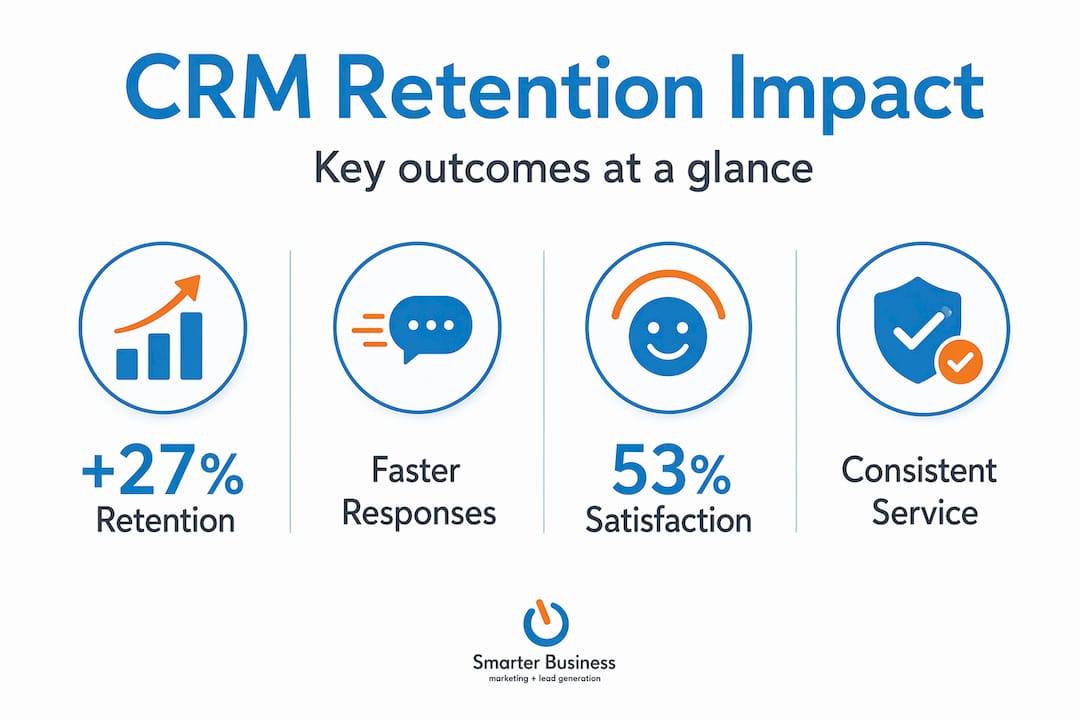
53% of CRM adopters report significant improvements in customer satisfaction, but the correlation is directly tied to how well the system is actually used. A CRM that half your team ignores is about as useful as a chocolate teapot.
Simple CRM systems consistently outperform complex feature-heavy platforms in SME environments because people actually use them. Set clear retention objectives before you deploy. Define what success looks like — a percentage improvement in renewal rates, a reduction in customer churn, a target satisfaction score. Then build your CRM workflows around those goals, not around every feature the software offers.
Pro Tip: Before going live with any CRM, run a 30-day pilot with your most engaged team members. Their feedback will reveal friction points that no software demo ever will. Fix those before company-wide rollout and your adoption rate will double.
Understanding the significance of CRM implementation from the start saves months of frustration and keeps your retention goals on track from day one.
My honest take on where businesses get this wrong
I have seen businesses spend significant money on CRM software and then treat it as a reporting tool for management rather than a working system for the people closest to customers. That is where the whole thing falls apart.
In my experience, the IT-CRM dimension is consistently the most neglected, and it shows. When your CRM does not talk to your email platform, your billing system, or your support desk, you end up with data silos — and data silos are where good customer relationships go to die. The technology is almost never the problem. The organisational commitment to connecting and maintaining it is.
What I have learned is that the businesses who retain customers best are not necessarily the ones with the most sophisticated CRM. They are the ones who picked a system their team would actually use, trained people properly, and reviewed their data regularly. The AI and predictive analytics capabilities are genuinely powerful, and I do encourage businesses to move toward them. But they only work on top of clean data and consistent habits.
The human side of retention — the timely call, the acknowledgement of a loyalty milestone, the proactive fix before a complaint — is what CRM makes possible at scale. Without the human intent behind it, no software solves anything.
— Patrick
See how Smarterbusiness can help you retain more customers

Smarterbusiness works with SMEs across Ireland to implement CRM solutions that actually get used — and actually improve retention. As Act! Certified Consultants, the Smarterbusiness team does not hand you software and wish you luck. They configure your system around your specific customer base, your workflows, and your retention goals. Whether you need CRM training for your team to drive adoption, or a customised CRM consultancy to align your platform with your business objectives, Smarterbusiness provides the support that turns a CRM licence into a genuine competitive advantage. Get in touch to start the conversation.
FAQ
What is the role of CRM in customer retention?
CRM supports retention by tracking customer interactions, centralising data, and enabling personalised, timely communication. All CRM dimensions positively influence customer satisfaction, which directly drives retention intention.
How much can CRM improve retention rates?
CRM can improve retention rates by up to 27% by giving teams full customer interaction context for faster, more personalised responses.
What are the best CRM practices for retention?
Set clear retention objectives before deployment, prioritise user adoption over feature complexity, and maintain consistent data quality. Simple CRM systems outperform complex ones when adoption rates are higher.
How does AI enhance CRM for customer retention?
AI-powered CRM analyses behavioural signals to predict churn risk and automate personalised outreach, shifting retention from reactive to proactive management.
How does CRM data enrichment help reduce churn?
Enriched CRM data reveals behaviour patterns that signal when a customer is at risk of leaving, allowing your team to intervene with targeted messaging or offers before the relationship breaks down.