You have 0 items in your cart

CRM implementation budget planning is the process of forecasting and allocating funds across every phase of CRM deployment, from initial licences through to ongoing management, so your business gets real value without nasty financial surprises. For Irish SMEs, total project costs range from €5,000 to €150,000 depending on complexity and user count. That is a wide range, and landing at the wrong end of it without a plan is a bit like ordering a round of drinks without checking your wallet first. The good news is that a structured approach to budgeting for CRM software puts you firmly in control of where every euro goes.
What are the typical costs of CRM implementation for SMEs?
Understanding the full cost picture is the foundation of any solid CRM project budget. Costs fall into several distinct categories, and treating licence fees as the only line item is where most SMEs come unstuck.
| Cost category | Typical range |
|---|---|
| Licence fees (per seat, per year) | €360 – €3,000 per user |
| Implementation and setup | €1500 – €30,000 |
| Data migration | €1,500 – €10,000 |
| Integrations and custom API work | €2,000 – €15,000 |
| Training and enablement | €1,000 – €8,000 |
| Ongoing admin and support | €2,000 – €8,000 per month |
Small businesses with 1 to 10 users typically invest €5,000 to €50,000 over a four to eight week project. Growing SMBs with 10 to 50 users should budget €20,000 to €150,000 over two to four months. Those figures are not scare tactics. They reflect what a properly resourced implementation actually costs when you account for everything.
-
Licence fees are the entry point, not the full story. Seat costs accumulate quickly as your team grows.
-
Data migration is rarely the tidy copy-paste job people hope for. Extensive data scrubbing and accurate field mapping are required to avoid the classic garbage-in, garbage-out trap that kills user adoption.
-
Integrations with tools like accounting software, e-mail platforms, or e-commerce systems often require custom connector work that vendors quote separately.
-
Training typically involves 4 to 8 hours of live sessions plus a two to four week productivity dip as staff get up to speed. That lost productivity represents real revenue, and it rarely appears on anyone’s initial budget sheet.
Pro Tip: Ask every vendor for a total cost of ownership figure, not just the monthly licence price. If they cannot produce one, that tells you something useful about how they operate.
Ongoing administration and support costs €2,000 to €8,000 per month and must be budgeted from day one. Treating these as a post-launch problem is how businesses end up with a CRM that works brilliantly for three months and then quietly becomes shelfware.

How should SMEs allocate their CRM budget strategically?
Smart allocation is what separates a CRM project that delivers measurable returns from one that drains the budget and demoralises the team. Experts recommend the following split for SME technology spend in 2026:
-
Core CRM platform: 30 to 40% of total budget. This covers licences, configuration, and the foundational setup that everything else depends on.
-
Marketing technology stack: 35 to 45%. E-mail automation, lead capture tools, and campaign management sit here. These tools amplify what your CRM captures.
-
AI and analytics: 10 to 20%. Reporting dashboards, predictive lead scoring, and workflow automation fall into this bracket.
-
Training and contingency: 5 to 15%. This is the category most SMEs underfund, and it is the one that saves them when reality diverges from the project plan.
The recommended 2026 allocation also advises reserving 10 to 15% of total budget as a contingency buffer for unexpected customisation, scope changes, or additional training needs. Think of it as the spare tyre in your boot. You hope you never need it, but you will be very glad it is there.
“Start budgeting by mapping CRM spend to company milestones and objectives rather than just listing subscriptions line by line.” — Annual tech budget planner
Linking your CRM project budget to specific business outcomes, such as reducing sales cycle length by 20% or improving customer retention by a defined percentage, gives every line item a justification. It also makes it far easier to defend the spend to stakeholders who are sceptical about technology investment.
Pro Tip: Schedule a quarterly budget reforecast from the moment you sign the contract. Organisations that tie spend to business outcomes and review regularly reduce tool bloat and consistently improve ROI.
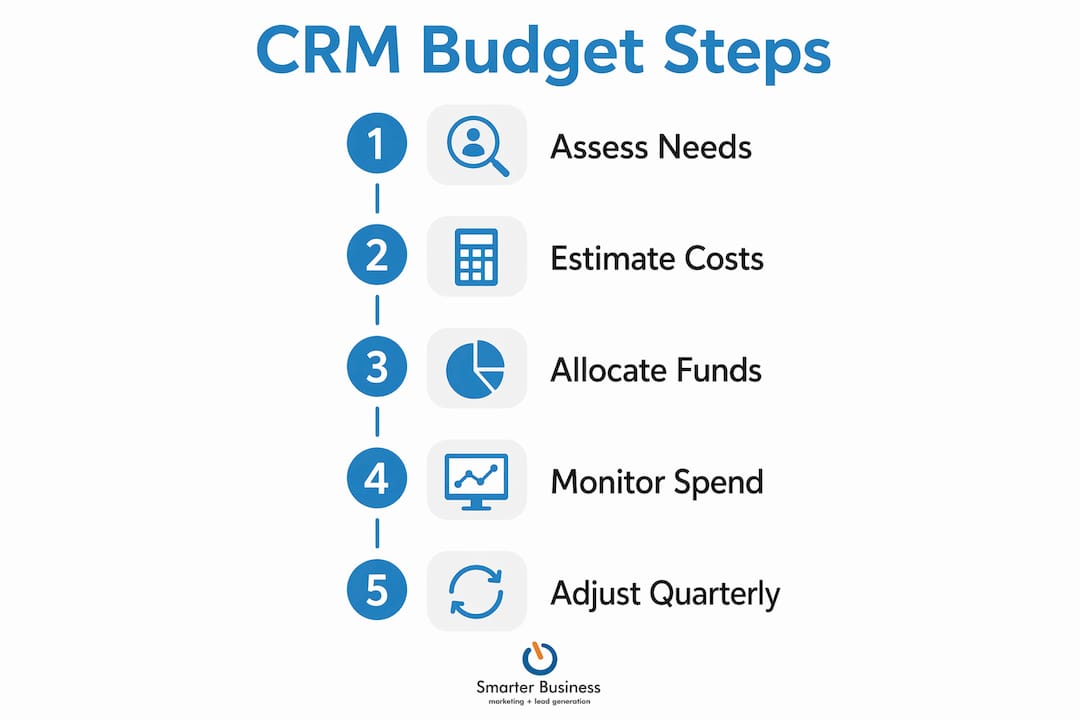
You can also use a weighted scoring model to prioritise budget initiatives. Score each proposed spend item against criteria like strategic impact, user adoption likelihood, and implementation risk. Items that score highly on all three get funded first.
What budgeting pitfalls should SMEs avoid during CRM implementation?
The gap between the budget you planned and the invoice you receive is almost always explained by a handful of predictable mistakes. Knowing them in advance is half the battle.
-
Underestimating internal team time. Mid-market CRM implementations typically require 80 to 150 hours from sales and operations leads for discovery, testing, and governance setup. That is time those people are not selling or managing. It is a genuine opportunity cost that belongs in your budget.
-
Ignoring data quality. Migrating dirty data into a shiny new CRM is like pouring muddy water into a clean glass. The data cleansing phase is consistently underestimated in both time and cost.
-
Seat creep. New hires, role changes, and department expansions quietly inflate your licence bill. Without a process to review seats quarterly, you end up paying for access that nobody uses.
-
Add-on inflation. CRM vendors are very good at making add-ons look affordable individually. Collectively, they can double your annual spend within eighteen months.
-
Skipping ongoing training. A one-off training session at launch is about as effective as reading the manual once and never opening it again. Budget for CRM training as a recurring line item, not a one-time event.
Pro Tip: Build a scope change protocol into your project governance from the start. Every request to add a feature or integration mid-project should go through a formal cost and timeline assessment before anyone says yes.
Choosing a CRM platform that matches your current organisational scale also matters. Paying for unnecessary features inflates your budget without adding proportionate value. A 12-person sales team does not need enterprise-grade territory management.
How to monitor and optimise your CRM budget post-implementation
Getting the CRM live is not the finish line. It is the starting pistol for ongoing cost management. Here is how to keep implementing CRM cost under control once you are up and running.
-
Conduct quarterly licence audits. Downgrade inactive users to view-only roles or remove them entirely. This single habit can save thousands of euros annually in mid-sized teams.
-
Consolidate overlapping tools. If your CRM, e-mail platform, and project management tool all offer similar features, you are likely paying three times for the same capability. Pruning tool sprawl is a best practice that keeps your tech stack lean.
-
Implement data retention policies. Storage costs grow silently. Archiving records older than a defined period reduces database size and, in some platforms, your monthly bill.
-
Negotiate vendor contracts proactively. Request price increase caps and flexible seat scaling before you sign. Vendors are far more accommodating before you are locked in than after.
-
Review ROI against defined KPIs every quarter. If a feature or integration is not contributing to a measurable outcome, it is a candidate for removal.
| Optimisation action | Frequency | Expected saving |
|---|---|---|
| Licence audit | Quarterly | 10 to 20% of seat costs |
| Tool consolidation review | Bi-annually | 15 to 30% of stack cost |
| Data retention clean-up | Annually | Variable, reduces storage fees |
| Contract renegotiation | At renewal | 5 to 15% on licence fees |
What I have learned about CRM budgeting after years working with Irish SMEs
Working with SMEs across Ireland since 2014, the single most consistent pattern I see is this: businesses that treat CRM budgeting as a one-time exercise before go-live almost always overspend or underdeliver. The ones that get it right treat the budget as a living document, reviewed quarterly and tied to actual business performance.
The other thing I would say plainly is that stakeholder engagement at the budgeting stage is not optional. When the people who will actually use the CRM have no input into what is being spent and why, adoption suffers. And poor adoption is the most expensive outcome of all, because you have paid for everything and gained nothing.
On contingency buffers: I recommend 15% rather than the commonly cited 10%. In my experience, the difference between a smooth implementation and a stressful one is almost always found in that extra five percentage points. Scope changes, data surprises, and staff turnover during a project are not edge cases. They are the norm.
Finally, do not let vendor enthusiasm substitute for your own due diligence. A CRM consultancy that understands your business processes will save you far more than the cost of their fees by helping you avoid expensive mistakes before they happen.
— Patrick Lennon
Key takeaways
Effective CRM implementation budget planning requires mapping all cost categories upfront, reserving a 15% contingency buffer, and reviewing spend against business outcomes every quarter.
| Point | Details |
|---|---|
| Know the full cost range | SME CRM projects cost €10,000 to €150,000 depending on team size and complexity. |
| Allocate strategically | Reserve 30 to 40% for core CRM, 5 to 15% for training and contingency. |
| Budget for hidden costs | Internal team time, data migration, and ongoing admin are consistently underestimated. |
| Audit licences quarterly | Removing inactive seats and consolidating tools reduces ongoing spend by 10 to 30%. |
| Link spend to outcomes | Tie every budget line to a measurable business KPI to justify and protect the investment. |
How Smarterbusiness helps SMEs plan and implement CRM with confidence
Planning a CRM budget without knowing what you actually need is like quoting a building job before you have seen the site. Smarterbusiness has been helping Irish SMEs get this right since 2014, working as practical CRM consultants rather than software sellers.
From helping you map realistic Act! CRM pricing to designing a phased implementation that fits your cash flow, Smarterbusiness builds budgets around how your business actually works. The team also provides structured CRM training programmes that prevent the productivity dip from becoming a productivity crater. If you want a CRM that your team actually uses and a budget that does not blow up on contact with reality, talk to the Smarterbusiness team today.
FAQ
What is a realistic CRM budget for a small business in Ireland?
Small businesses with 1 to 10 users should budget between €10,000 and €50,000 for a full CRM implementation, covering licences, setup, data migration, and training. Ongoing administration costs add €2,000 to €8,000 per month.
What hidden costs should I include in my CRM project budget?
The most commonly missed costs are internal staff time (80 to 150 hours for mid-market projects), data cleansing, productivity loss during training, and recurring licence inflation from seat creep.
How much contingency should I reserve for a CRM implementation?
Reserve at least 10 to 15% of your total budget as a contingency buffer to cover unexpected customisation, scope changes, or additional training requirements that arise during the project.
How often should I review my CRM spend after go-live?
Quarterly reviews are the recommended standard. Auditing licences, consolidating overlapping tools, and checking spend against KPIs every three months prevents cost creep and keeps your investment aligned with business outcomes.
Does choosing the right CRM platform affect my overall budget?
Selecting a platform that matches your current team size and processes avoids paying for features you will never use. Overpaying for enterprise-grade functionality as a 15-person SME is one of the most common and most avoidable budget mistakes.