You have 0 items in your cart

You bought the CRM. You got everyone logged in. You even ran a half-day training session with biscuits and good intentions. Job done, right? Not quite. Why CRM training matters is one of the most misunderstood questions in small business management, and the gap between “we have a CRM” and “we actually use it well” is wider than most managers expect. The truth is that a CRM without proper, ongoing training is a bit like a sports car with no fuel. Impressive in the driveway. Going nowhere fast.
Table of Contents
- Key takeaways
- The real business impact of CRM training
- Why one-off training always falls flat
- How CRM training improves sales effectiveness
- CRM training best practices for SMEs
- My take on the real challenge
- How Smarterbusiness can help your team
- FAQ
Key takeaways
| Point | Details |
|---|---|
| One-off training is not enough | Most training content is forgotten within 24 hours without reinforcement and regular follow-up. |
| Structured training drives revenue | Formal CRM education programmes can lead to a 6.2% revenue increase and 7.4% improvement in customer retention. |
| Role-based learning reduces resistance | Generic training causes cognitive overload. Tailoring content to each role increases adoption and daily usage. |
| Sales cycles get shorter | Businesses with well-trained CRM users are 86% more likely to exceed sales goals and shorten sales cycles by 8 to 14 days. |
| Training is a leadership priority | CRM training succeeds when managers actively coach their teams using live CRM data, not just at onboarding. |
The real business impact of CRM training
Let’s start with the numbers, because they tell a story that most SME owners find genuinely surprising. Formal CRM education programmes lead to a 6.2% revenue increase and a 7.4% improvement in customer retention. That is not a marginal gain. For a business turning over €500,000 per year, a 6.2% revenue uplift is an extra €31,000. From training.
The reason this works is not magic. It is data quality. When your team knows how to use the CRM properly, they log the right information, at the right time, in the right fields. That clean data then becomes genuinely useful. You can spot which customers are drifting, which deals are stalling, and which opportunities are ripe for follow-up. Integration of CRM training data can even predict customer churn months before a renewal is due, simply by monitoring how engaged customers are with your product or service.
Without proper training, your CRM becomes a glorified address book. With it, you have a tool that actively supports decision-making, forecasting, and growth.
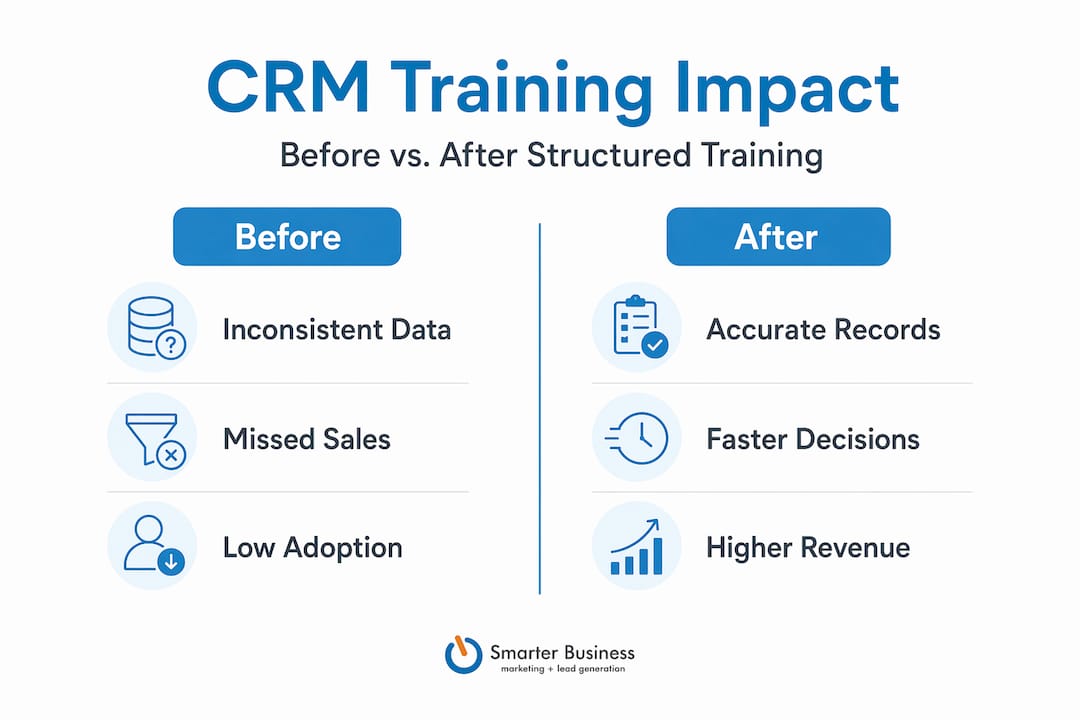
| Without CRM training | With structured CRM training |
|---|---|
| Inconsistent data entry across the team | Clean, standardised records everyone can rely on |
| CRM seen as extra admin work | CRM used as a daily sales and operations tool |
| Managers guessing at pipeline health | Accurate forecasting based on real, up-to-date data |
| High staff frustration and low adoption | Confident users who see personal benefit in the system |
Pro Tip: Track your CRM data quality before and after a structured training programme. Fields left blank, duplicate records, and overdue follow-up tasks are all measurable indicators of where training is making a real difference.
Why one-off training always falls flat
Here is an uncomfortable truth. Most businesses treat CRM training like a plaster. Apply it once, consider it done, and wonder why the wound keeps opening. The problem is that 70% of training content is forgotten within 24 hours without reinforcement. That half-day session you ran in January? Your team has forgotten most of it by February.
High-performing teams approach this very differently. They build a rhythm of learning that feels less like a corporate obligation and more like a normal part of how work gets done. The pattern that actually works looks something like this:
- Weekly: Short, focused check-ins on specific CRM features or common usage issues (15 minutes is enough)
- Monthly: A deeper skill session focused on one area, such as pipeline reporting or contact segmentation
- Quarterly: A review of how the CRM is actually being used, what is working, and what needs to change
The second problem with one-size-fits-all training is that it tries to teach everyone everything at once. Generic CRM training causes cognitive overload and actually drives system avoidance. Your accounts person does not need to know how to manage a sales pipeline. Your sales rep does not need to understand invoice workflows. When training is not relevant to what someone does every day, they switch off. And then they stop using the system altogether.
Role-based modules solve this. Each person learns what is directly relevant to their job, sees the benefit immediately, and is far more likely to carry the habit forward. As the importance of CRM training research consistently shows, effective training highlights “what’s in it for me” for each user, which is the single most reliable way to reduce resistance and build genuine adoption.
Pro Tip: When rolling out CRM training for teams, ask each department to identify their three most common daily tasks in the CRM. Build the training around those tasks first. Relevance is the fastest route to adoption.
How CRM training improves sales effectiveness
If the data quality argument does not convince you, the sales impact argument almost certainly will. Businesses using integrated CRM systems are 86% more likely to exceed sales goals, and they shorten their sales cycles by 8 to 14 days. That kind of pipeline velocity is worth significant money in any SME.
Here is how that actually plays out in practice when your team is properly trained:
- Faster qualification. Trained reps know how to log and interpret engagement signals. They stop chasing cold leads and focus on prospects who are genuinely ready to buy.
- More personalised outreach. When reps understand how to use CRM data, they can tailor every conversation to what a prospect actually needs, rather than delivering the same pitch to everyone.
- Less time on admin. A strong CRM experience reduces the time spent on administrative tasks, freeing reps to spend more time actually selling. That shift from admin-heavy work to consultative selling raises close rates meaningfully.
- Better forecast accuracy. Managers who know how to read CRM reports can spot problems early and redirect effort before a deal is lost.
The link between how CRM training improves sales and genuine operational efficiency is direct. It is not a coincidence that your best-performing salespeople tend to be your most disciplined CRM users.
CRM training best practices for SMEs

Getting CRM training right does not require a large budget or a dedicated learning and development team. It requires intention, consistency, and a willingness to treat training as an ongoing activity rather than a project with an end date.
The most effective approach starts with alignment. Your training programme should mirror the actual workflows your team follows every day. If your sales process has five stages, your CRM training should walk through each one, using real examples from your own business. Abstract demonstrations of features nobody uses are about as useful as a chocolate teapot.
Manager-led coaching on CRM data is consistently identified as the most critical factor in training success. When managers use CRM data in their one-to-one conversations, in their pipeline reviews, and in their performance discussions, they send a clear signal that the system matters. When they do not, staff quickly conclude that it does not.
Feedback loops are equally important. Without them, knowledge gaps widen quietly until they become serious adoption problems. Build in regular moments to ask the team what is confusing, what they are not using, and why. The answers will sharpen every subsequent training session considerably.
Pro Tip: Connect your CRM training to business outcomes your team already cares about. “This will help you close deals faster” lands better than “this will improve data quality.” Same outcome. Very different motivation.
My take on the real challenge
I have been working with SMEs on CRM adoption since 2014, and I can tell you honestly that the biggest obstacle is never the software. The technology is the easy part. What is genuinely difficult is the culture shift required to make CRM a natural part of how people work.
I have seen businesses invest thousands in a CRM platform and then spend nothing on training, then wonder why nobody is using it six months later. The system sits there like an expensive piece of gym equipment gathering dust. In my experience, the businesses that get genuine return from their CRM are the ones where leadership treats training as a strategic commitment, not a box to tick. They coach with data. They celebrate good CRM habits. They revisit training regularly rather than treating it as a one-time obligation.
The resistance to CRM adoption often comes from employees who feel the system is watching them rather than helping them. Transparency and role-specific training fix that faster than any feature update ever will. When someone sees their own pipeline becoming clearer, their follow-ups more organised, and their manager using the data to support them rather than scrutinise them, that is when CRM training stops feeling like a burden and starts feeling like an advantage.
— Patrick Lennon
How Smarterbusiness can help your team
At Smarterbusiness, we have spent over a decade helping Irish SMEs turn their CRM from a source of frustration into something their teams actually want to use. We offer role-based CRM training courses designed specifically for small and medium-sized businesses, built around real workflows rather than generic feature demonstrations. Whether your team is just getting started with Act! CRM or you have been using it for years and suspect you are only scratching the surface, we can help. Our CRM consultancy service goes beyond training to configure your system around how your business actually operates, so adoption becomes natural rather than forced. Get in touch with us today and let’s make your CRM work the way it should.
FAQ
Why does CRM training matter for small businesses?
CRM training matters because even the best system delivers poor results if your team does not know how to use it effectively. Structured training improves data quality, increases adoption, and directly supports revenue growth and customer retention.
How often should CRM training take place?
High-performing teams use weekly reinforcement, monthly skill sessions, and quarterly reviews. A single training session is not enough, as 70% of content is forgotten within 24 hours without follow-up.
What are the main benefits of role-based CRM training?
Role-based training reduces cognitive overload by focusing each team member on the features relevant to their job. This increases engagement, reduces system avoidance, and improves day-to-day CRM usage across the organisation.
How does CRM training improve sales performance?
Trained sales teams use CRM data to qualify leads faster, personalise outreach, and spend less time on administrative tasks. Businesses with well-trained CRM users are 86% more likely to exceed sales goals and shorten their sales cycles by up to 14 days.
What is the biggest reason CRM training programmes fail?
The biggest reason is the absence of structured feedback loops and manager-led coaching. Without managers actively using CRM data in team discussions, training rarely translates into lasting behavioural change on the ground.