You have 0 items in your cart
Irish refers not only to the people of Ireland but also to its native language, Gaeilge, its rich cultural traditions, and the social values that together shape a distinct national identity recognised across the world. Whether you are planning a trip to Galway, exploring your heritage, or building business relationships in Dublin, understanding what it truly means to be Irish goes well beyond shamrocks and St. Patrick’s Day. This guide covers the language, festivals, social customs, and symbols that define Irishness in 2026, giving you a genuinely useful foundation rather than a postcard version of the story.
What is the irish language and where is it spoken?
Irish (Gaeilge) is the first official language of the Republic of Ireland, enshrined in the Constitution ahead of English. That said, English dominates nearly 100% of government business in practice. The gap between constitutional status and daily use is one of the most fascinating tensions in modern Irish life.
Gaeilge survives most vigorously in the Gaeltacht regions, a collection of communities concentrated along the western seaboard. These areas include parts of Donegal, Mayo, Galway, Kerry, and Cork, and they carry enormous cultural weight far beyond their population size.
| Gaeltacht Region | County | Notable Feature |
|---|---|---|
| Connemara | Galway | Largest Irish-speaking community |
| Gweedore (Gaoth Dobhair) | Donegal | Strong traditional music tradition |
| Dingle Peninsula (Corca Dhuibhne) | Kerry | Active language preservation programmes |
| Múscraí | Cork | Rural community-led language events |
Language preservation efforts include TG4, the Irish-language television channel, and Raidió na Gaeltachta, the national Irish-language radio service. Both reach audiences well beyond the Gaeltacht itself. Technology is also playing a growing role, with platforms like Duolingo and dedicated apps helping learners worldwide engage with Gaeilge for the first time.
Pro Tip: If you visit a Gaeltacht region, even a simple “Go raibh maith agat” (thank you) will earn you genuine warmth from locals. Participation matters far more than perfection.
Which traditional irish festivals still thrive in 2026?
Ireland’s traditional festivals blend pagan and Christian elements in ways that are genuinely unique. This syncretism is not accidental. It reflects centuries of cultural layering, where pre-Christian Celtic rituals were absorbed into, rather than replaced by, Christian practice.
The major festivals worth knowing:
-
Bealtaine (1st May): Marks the Celtic start of summer. Bealtaine involves fire and water rituals believed to protect crops and livestock. Communities light bonfires, and cattle were traditionally driven between two flames for protection. In 2026, Bealtaine is celebrated through arts festivals, community bonfires, and folk events across rural Ireland.
-
Samhain (31st October): The origin of Halloween. Samhain marks the point where the boundary between the living and supernatural worlds thins. Costumes, divination games, and communal gatherings all trace back to this ancient festival.
-
Easter: Irish Easter customs include a mock funeral for a herring, symbolising the end of Lenten fish consumption. This is the kind of detail that does not appear on tourist brochures but tells you everything about how Irish traditions retain folk customs as cultural habits rather than strictly religious acts.
-
St. Patrick’s Day (17th March): The most globally recognised Irish festival. In Ireland itself, celebrations range from the grand Dublin parade to quiet community Masses in rural parishes. The contrast between the international spectacle and the local reality is striking.
Regional variations are significant. County Clare celebrates traditional music far more prominently than, say, Dublin’s commercial St. Patrick’s festivities. Attending a local festival rather than a city-centre event gives you a completely different experience of Irish culture.
Pro Tip: Bealtaine arts festivals, particularly the one run by Age & Opportunity Ireland, are genuinely moving and far less crowded than the big city events. Worth seeking out.
What core values define the irish way of life?
Understanding Irish social customs requires moving past surface impressions. The values below are not stereotypes. They are observable patterns with real cultural roots.
-
Céad Míle Fáilte. Translated as “a hundred thousand welcomes,” this phrase captures genuine cultural warmth rooted in historical community interdependence. In rural Ireland especially, hospitality was a survival mechanism. Visitors were offered food, shelter, and company because communities depended on mutual aid. That instinct has not disappeared.
-
Craic. This is not simply the Irish word for fun. Craic is a nuanced social skill involving wit, storytelling, and active participation in lighthearted exchanges. You cannot observe craic from the sidelines. You have to join in. Think of it as a social currency where the willingness to contribute a story or a laugh is the price of entry.
-
Time flexibility. In rural social settings, timekeeping is loose by design. Quality of interaction takes priority over schedules, which can feel disorienting if you arrive expecting a 7pm start to mean 7pm. Urban business settings follow standard professional norms, but social gatherings operate on their own clock.
-
Politeness and group harmony. Direct confrontation is generally avoided in favour of indirect communication. Saying “that’s grand” can mean anything from genuine approval to polite disagreement. Reading the room matters.
-
Storytelling and humour. Ireland produced Samuel Beckett, Oscar Wilde, Seamus Heaney, and Roddy Doyle. The literary tradition is not separate from everyday life. Humour, self-deprecation, and narrative are woven into ordinary conversation in a way that visitors often find immediately disarming.
What symbols best represent irish identity?
Irish cultural symbols carry layered meanings that reward closer inspection.
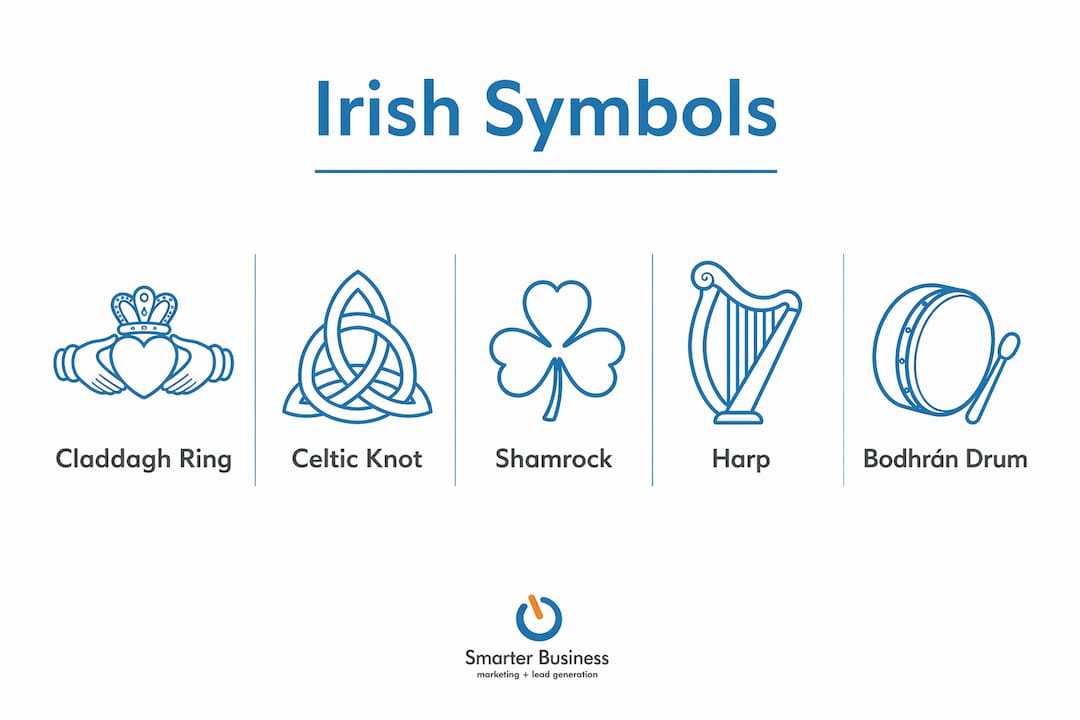
| Symbol | Origin | Meaning |
|---|---|---|
| Claddagh Ring | Galway, 1700s | Love (heart), loyalty (crown), friendship (hands) |
| Shamrock | Pre-Christian Ireland | Associated with St. Patrick’s teaching on the Trinity |
| Harp | Medieval Ireland | National emblem; appears on Euro coins and state documents |
| Celtic Knotwork | Early Christian manuscripts | Continuity, eternity, interconnection |
The Claddagh ring originated in Galway in the 1700s and is worn differently depending on relationship status. Worn on the right hand with the heart facing outward signals availability. On the left hand with the heart facing inward signals commitment. Generations pass these rings down as family heirlooms, making them living objects rather than mere jewellery.
Traditional Irish music uses instruments including the fiddle, tin whistle, uilleann pipes, and bodhrán. Sessions in pubs across Clare, Galway, and Dublin keep this heritage alive and participatory. The uilleann pipes in particular are one of the most technically demanding instruments in any folk tradition worldwide, requiring years of practice to play well.
Irish cultural identity, as Tourism Ireland notes, is an active tradition built on participation rather than preservation behind glass. That distinction matters enormously for anyone wanting to engage authentically.
Key takeaways
Irish identity is best understood as a living, participatory culture shaped by language, syncretic traditions, social values, and iconic symbols that remain genuinely active in 2026.
| Point | Details |
|---|---|
| Language status | Gaeilge is Ireland’s first official language, concentrated in Gaeltacht regions along the western seaboard. |
| Festival syncretism | Major festivals like Bealtaine and Samhain blend Celtic and Christian elements, reflecting centuries of cultural layering. |
| Social currency | Craic is a participatory social skill involving wit and storytelling, not simply a word for fun. |
| Hospitality roots | Céad Míle Fáilte reflects historical community interdependence, not just a tourism slogan. |
| Living symbols | The Claddagh ring, harp, and traditional music sessions are active cultural practices, not museum pieces. |
Why authentic engagement beats armchair appreciation
I have spent years working with Irish businesses and community organisations, and the single most common mistake outsiders make is treating Irish culture as a spectacle rather than an invitation. You can read every book about Samhain or Bealtaine and still miss the point entirely if you watch from the edge of the field rather than joining the bonfire circle.
The language question is where I feel most strongly. Gaeilge is not a dying curiosity. It is a living system of thought that encodes ways of seeing the world that English simply cannot replicate. The Irish phrase “tá brón orm” literally means “sadness is on me,” not “I am sad.” That is not a grammatical quirk. It is a fundamentally different relationship between a person and an emotion. Businesses and individuals who engage with that depth, rather than skimming the surface, build far more genuine connections in Ireland.
The challenge for language preservation is not enthusiasm. There is plenty of that. The challenge is infrastructure: schools, digital tools, and economic incentives for Gaeltacht communities. Technology platforms are beginning to close that gap, but the work is far from finished.
— Patrick Lennon
How Smarterbusiness supports irish organisations
Irish cultural organisations and SMEs share a common challenge: managing relationships, events, and community data without the right tools. A spreadsheet is about as useful for tracking festival attendees or donor relationships as a chocolate teapot is for brewing tea. Smarterbusiness has been helping Irish businesses and organisations get their customer and contact management sorted since 2014, with CRM training tailored for Irish teams that fits how your organisation actually works, not how a software manual says it should.

Whether you run a cultural initiative, a tourism business, or a community organisation, Smarterbusiness builds systems around your workflows, your terminology, and your people. No generic setups. No wasted licences. Just practical CRM that your team will actually use. Explore Act! CRM products designed for Irish businesses, or speak to the team directly about what would work for you.
FAQ
What does “irish” mean as a cultural identity?
Irish refers to the people, language, traditions, and social values of Ireland, encompassing both the Republic of Ireland and the island’s broader heritage. It is an ethnic, linguistic, and national identity with distinct cultural markers including Gaeilge, Celtic festivals, and the concept of céad míle fáilte.
Where is the irish language spoken today?
Gaeilge is spoken primarily in Gaeltacht regions along Ireland’s western seaboard, including parts of Donegal, Galway, Mayo, Kerry, and Cork. English dominates daily and governmental life across the rest of the country.
What is the difference between samhain and halloween?
Samhain is the ancient Celtic festival from which Halloween directly descends. It marks the point where the boundary between the living and supernatural worlds was believed to thin, and it predates Christian influence in Ireland by centuries.
What is craic and how do you experience it?
Craic is a social concept involving wit, storytelling, and participatory humour that functions as a form of social currency in Irish life. You experience it by joining in rather than observing, whether in a pub session, a community event, or an ordinary conversation.
How can businesses engage authentically with irish culture?
Businesses engage authentically by participating in community events, learning basic Gaeilge phrases, and understanding that Irish social values prioritise relationship quality over transactional efficiency. Genuine interest in local traditions builds trust far faster than any marketing campaign.