You have 0 items in your cart

An Irish consultant is a professional advisor who helps business owners improve organisational strategy, operational efficiency, and governance for sustained growth. The term covers a broad range of specialists, from firms like Indecon International Consultants and Teneo Ireland to independent practitioners like Paul Davis. What unites them is a focus on diagnosing real business problems and delivering practical solutions, not just polished slide decks. If your business feels like you are playing whack-a-mole with the same problems every quarter, a business advisor is probably overdue.
What types of Irish consultant services suit your business?
Consulting services in Ireland typically fall into three broad categories, and knowing which one you need saves time and money from the outset.
- Strategic governance consulting covers board structure, ownership planning, and long-term direction. Family businesses particularly need this because family dynamics and strategy are more intertwined than most owners admit. Failure to address ownership and family governance early creates conflicts that a standard operational consultant simply cannot resolve.
- Financial advisory includes restructuring, risk management, and value protection. Experienced owners often value consultants more for risk mitigation than growth advice. Early consultant involvement in critical reviews and restructuring can prevent a crisis from becoming an insolvency.
- Operational and digital transformation covers process improvement, technology adoption, and change management. This is where tools like Act! CRM and workflow systems come into play for SMEs looking to make their day-to-day operations less chaotic.
Engagement models vary just as much as service types. Project-based engagements suit defined problems with clear deliverables. Long-term advisory retainers work better when you need ongoing support as your business evolves. Mentoring sits somewhere in between, though it is often confused with private advisory, which is a different thing entirely.
How do you choose the right expert consultant in Ireland?
Choosing a consultant is a bit like hiring a new senior manager. You would not skip the interview, so do not skip the assessment either.

Executive assessment tools are standard practice in Ireland for evaluating advisor suitability at management and board level. These tools measure cultural fit and leadership capability before any formal engagement begins. That matters because a consultant who clashes with your team’s way of working will create friction, not results.
The criteria worth assessing before you sign anything:
- Sector experience: Has the consultant worked with businesses of your size and type in Ireland?
- Cultural fit: Do they communicate in a way your team will actually respond to?
- Track record: Can they point to specific outcomes, not just activities?
- Engagement style: Are they transactional or relational? The difference shows up fast.
- OGP framework status: For major projects, OGP-ranked firms carry verified competence in organisational change and transformation services.
The Office of Government Procurement framework is a quality assurance benchmark clients use to select consulting firms for complex Irish projects. It is not just a public sector concern. Private businesses use OGP rankings as a shorthand for verified capability.
Pro Tip: Ask any prospective consultant to describe a situation where their advice did not go as planned and what they did about it. The answer tells you more about their character than any case study.
Private advisory vs consulting vs mentoring: what is the difference?
Most business owners use these three terms interchangeably. They should not.
Private advisory is a trust-based, long-term relationship that provides support when leadership complexity becomes genuinely overwhelming. It is not a project with a start and end date. It is not a coaching session with homework. Paul Davis describes it as the kind of support business owners need when the weight of decisions feels too heavy to carry alone. That is a fundamentally different proposition from hiring a consultant to fix your supply chain.
“Business owners often need private advisory during complex leadership loads rather than project consultancies.” — Paul Davis Advisory
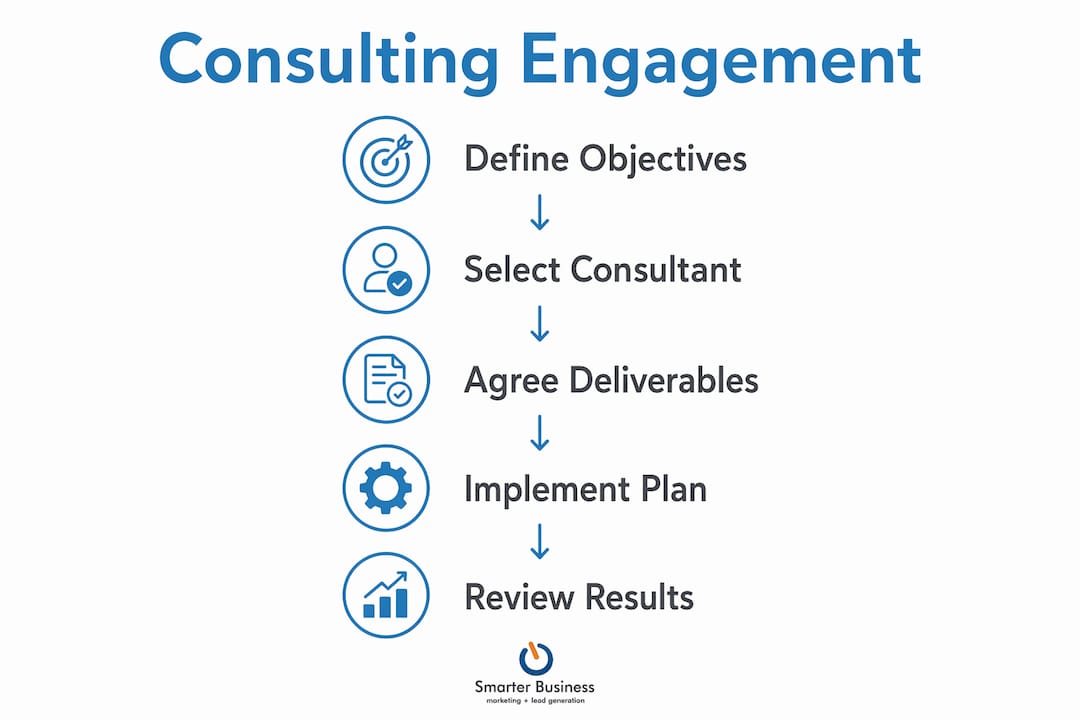
Standard consulting is project-bound. You define the problem, agree the deliverables, pay the fee, and the engagement ends. That model works well for discrete challenges like a market entry strategy or a financial restructuring. Mentoring sits closer to coaching, focused on developing the owner’s own capabilities over time. Private advisory, by contrast, is about having a trusted sounding board who knows your business deeply and is available when things get complicated.
The practical question is: which do you actually need right now? If you have a specific problem with a clear answer, hire a consultant. If you are building your own leadership capability, find a mentor. If you are carrying the weight of the whole business and need someone genuinely in your corner, private advisory is the right fit.
How to engage a consultant to improve strategy and operations
Getting value from a consulting engagement does not happen by accident. It requires preparation on your side as much as expertise on theirs.
- Define your objectives clearly. Vague briefs produce vague results. Write down the specific outcome you want before the first meeting.
- Clarify deliverables and timelines. A good consultant will push back if your expectations are unrealistic. That is a feature, not a fault.
- Establish a trusted working relationship. Customised consulting teams assembled from diverse centres of excellence outperform generic approaches, especially during crises or complex periods. The relationship quality drives the outcome quality.
- Involve them early. Waiting until a problem becomes a crisis is the most expensive way to use a consultant. Early engagement for critical reviews and restructuring protects value before it erodes.
- Review progress against outcomes, not activity. Measure what changed, not how many meetings happened.
| Engagement stage | What to focus on |
|---|---|
| Before engagement | Define objectives and success criteria |
| Selection | Assess cultural fit, sector experience, and OGP status |
| Onboarding | Agree deliverables, timelines, and communication cadence |
| During engagement | Review outcomes regularly, not just activities |
| Post-engagement | Capture lessons and decide on ongoing advisory needs |
Pro Tip: If a consultant cannot explain their approach in plain language within five minutes, they probably do not understand your business well enough yet. Keep asking until the answer is clear.
Key takeaways
Choosing the right Irish business advisor requires matching the type of engagement to the actual problem, not just hiring the most credentialled firm available.
| Point | Details |
|---|---|
| Match the engagement type | Choose project consulting, private advisory, or mentoring based on your specific need. |
| Assess fit before signing | Use cultural fit and leadership capability assessments before formal engagement begins. |
| Involve consultants early | Early engagement for restructuring and critical reviews prevents crises from becoming insolvencies. |
| Governance matters for family businesses | Integrating ownership and family governance early prevents conflicts standard consultants cannot resolve. |
| OGP framework signals quality | OGP-ranked firms carry verified competence for complex organisational change projects in Ireland. |
Why relational trust beats transactional consulting every time
Patrick Lennon, founder of Smarterbusiness, shares his perspective:
I have worked with Irish business owners long enough to know that the ones who get the most from consultants are not the ones who hire the most expensive firm. They are the ones who invest in the relationship. A consultant who knows your business, your team, and your blind spots is worth ten times a consultant who delivers a polished report and disappears.
The thing that surprises most owners is how much governance matters, even in small businesses. You do not need a board of twelve to benefit from clear ownership structures and decision-making frameworks. I have seen family businesses tear themselves apart over issues that a governance-focused advisor could have resolved in a few sessions, if they had been brought in before the conflict escalated.
My honest advice: do not wait for a crisis. The best time to build a trusted advisory relationship is when things are going reasonably well and you have the headspace to actually listen. By the time the wheels are coming off, you are paying for emergency rates and working against the clock.
— Patrick Lennon
How Smarterbusiness supports Irish business operations
Smarterbusiness has been working with Irish SMEs since 2014, not as software sellers, but as certified CRM consultants who tailor systems to fit how a business actually functions.
The approach mirrors what the best Irish business advisors do: start with the real operational challenge, then build the solution around it. Smarterbusiness customises Act! CRM to align with your workflows, reporting structures, and team processes. Whether you need CRM training for your team or a full system build from scratch, the focus is always on making the technology practical, not impressive. If your operations feel like a greased pig that nobody can quite catch, that is exactly the kind of problem Smarterbusiness was built to solve.
FAQ
What does an Irish consultant actually do?
An Irish consultant provides expert advice to help business owners improve strategy, operational efficiency, and governance. Engagements range from short-term projects to long-term advisory relationships depending on the business need.
How is private advisory different from standard consulting?
Private advisory is a trust-based, ongoing relationship for business owners facing complex leadership decisions, while standard consulting is project-bound with defined deliverables and an end date.
What is the OGP framework and why does it matter?
The Office of Government Procurement framework ranks consulting firms on verified competence in organisational change. Clients use OGP rankings as a quality benchmark when selecting firms for major projects in Ireland.
When should a business owner hire a consultant?
Early engagement for critical reviews and restructuring protects business value before problems escalate. Waiting for a crisis is the most expensive approach.
Do family businesses need a different type of consultant?
Yes. Family business governance requires specialised expertise in ownership structures and family dynamics that standard operational consultants are not equipped to address.