You have 0 items in your cart

Donor relationship management (DRM) is the process of thoughtfully and proactively cultivating relationships with new donors and stewarding current donors to maximise retention, engagement and long-term investment in your cause. Think of it less as a filing system and more as the connective tissue between your mission and the people who fund it.
At its core, DRM pulls together four elements:
- Data and governance — clean, structured records of who your donors are and what they care about
- Segmentation — grouping supporters by value, potential and behaviour so your team focuses effort where it counts
- Stewardship — planned, meaningful interactions that go well beyond the annual ask
- Personalised communications — the right message, to the right person, at the right moment
Get those four working together and the outcomes are measurable: higher donor retention rates, greater lifetime value per supporter, and a lower cost of acquiring each new donor.
Key takeaways
Donor relationship management is the strategic discipline that converts one-time givers into long-term mission partners — and it requires clean data, defined processes, and the right CRM configuration working together.
| Point | Details |
|---|---|
| DRM is a process, not a platform | Define stewardship workflows and segment ownership before configuring any CRM system. |
| Retention beats acquisition on cost | Retaining existing donors is more cost-effective than replacing them; track retention rate quarterly. |
| Four pillars to audit | Data governance, segmentation, stewardship communications, and measurement form the practical foundation. |
| UK compliance is non-negotiable | GDPR consent, ICO direct-marketing rules, and Gift Aid declaration records must be built into your CRM from day one. |
| Smarterbusiness for implementation | Smarterbusiness configures Act! CRM to match your DRM workflows, consent fields, and stewardship sequences — not the other way around. |
Table of Contents
- Why DRM matters more than your next fundraising campaign
- The four pillars that hold effective DRM together
- Donor lifecycle stages and the people who own each one
- How to implement DRM inside your organisation, step by step
- Which CRM features actually drive better donor relationships?
- Key metrics to track and how to calculate them
- Common pitfalls that quietly wreck DRM programmes
- UK compliance, Gift Aid, and the stewardship principle that changes everything
- Practical tactics you can test this quarter
- A CRM consultant’s honest view on where DRM projects go wrong
- Smarterbusiness can help you build a DRM programme that actually works
- Sources
Why DRM matters more than your next fundraising campaign
Most fundraising teams spend the majority of their energy chasing new donors. That is a bit like filling a leaky bucket and calling it progress. Retaining an existing donor is consistently more cost-effective than acquiring a new one, and sector commentary points to falling retention rates in recent years, making a structured DRM programme an urgent priority for income stability rather than a nice administrative exercise.
The strategic benefits stack up quickly:
- Predictable income — retained donors give more reliably, making cash flow forecasting far less of a guessing game
- Higher lifetime value — a donor who stays for five years is worth exponentially more than five one-year donors, even if the annual gift is identical
- Major-gift pipeline — mid-level donors who feel genuinely connected to your mission are the most natural candidates for a major or legacy gift conversation
- Better stewardship reporting — structured DRM gives trustees and funders evidence of responsible relationship management, not just transaction records
- Reduced acquisition pressure — every donor you retain is one fewer you need to replace
Understanding why CRM investment pays off is the same logic applied to donor relationships: the system only earns its keep when the underlying process is sound.
Pro Tip: *Before launching any new acquisition campaign, pull your retention rate for the last 12 months.
The four pillars that hold effective DRM together
The DRG Group’s framework identifies acknowledgement, stewardship, recognition and engagement as the four pillars of donor relations. That is a useful audit checklist on its own, but here is how each pillar translates into daily practice.
Pillar 1: Data and governance
Your donor data is only as useful as it is accurate. Duplicate records, missing consent flags, and outdated contact details are not just annoying — they are compliance risks and stewardship failures waiting to happen. Success here looks like a single, clean record per supporter with a full interaction history, valid consent status, and Gift Aid declaration where applicable.
Quick audit questions:
- Do you have one canonical record per donor, or are duplicates lurking?
- Is consent recorded at the field level, not just assumed?
- When did you last run a data-quality check?
Pillar 2: Segmentation and prioritisation
Not every donor deserves the same level of attention — and pretending otherwise burns out your team. Segment by value and potential, then allocate staff time accordingly. A major-donor portfolio of 20 relationships managed personally by a senior fundraiser will outperform a generic newsletter sent to 2,000 lapsed donors every time.
Quick audit questions:
- Do you have defined segments (e.g. new, regular, lapsed, major, legacy-interested)?
- Is each segment assigned a clear owner and a minimum contact frequency?
Pillar 3: Stewardship and personalised communications
Stewardship is what happens between the asks. Impact reports, personal thank-you calls, event invitations, and mission updates all count. Strong stewardship converts donors from transactional revenue sources into mission partners — and that shift is what drives sustainable funding.
Quick audit questions:
- How many touchpoints does a typical donor receive in a year that are not an ask?
- Are communications personalised beyond first name?
Pillar 4: Measurement and continuous improvement
If you cannot measure it, you cannot improve it. Track retention rate, average gift, and donor lifetime value at minimum. Review them quarterly, not annually.
Quick audit questions:
- Which KPIs does your team report to trustees?
- When did you last act on a dip in retention rate?
Donor lifecycle stages and the people who own each one
A donor relations manager plans, directs and coordinates activities to move supporters through the lifecycle — but the whole team has a role. Here is how the stages break down.
The five stages:
- Acquisition — identifying and converting a prospect into a first-time donor; primary objective is a low-friction first gift
- Cultivation — building the relationship before and between asks; primary objective is deepening connection to the mission
- Stewardship — thanking, reporting impact and recognising the donor; primary objective is making the donor feel their gift mattered
- Retention — securing the second and subsequent gifts; primary objective is converting a one-time giver into a loyal supporter
- Advocacy — turning loyal donors into champions who recruit others or consider a legacy gift; primary objective is expanding reach without acquisition cost
Who typically owns each stage:
- Acquisition: marketing officer, digital fundraiser, events team
- Cultivation: fundraising officer, relationship manager
- Stewardship: stewardship lead, database manager (for automated touchpoints), CEO (for major donors)
- Retention: fundraising officer, CRM administrator
- Advocacy: senior fundraiser, board members, CEO
How donors typically move between stages:
- First gift received → automated welcome series triggered → cultivation plan assigned
- Second gift received → segment reviewed → stewardship frequency increased
- 12 months without a gift → lapsed flag applied → re-engagement sequence started
- Major-gift threshold reached → personal portfolio assigned → cultivation plan escalated
Collecting donor feedback via surveys and syncing it to CRM records at each stage gives your team the data to make those transitions deliberate rather than accidental.
How to implement DRM inside your organisation, step by step
Setting up DRM is not a software project. It is a process project that happens to need software. Here is a practical roadmap.
- Define your goals and success metrics — before touching any data, agree what good looks like: target retention rate, average gift growth, number of major-donor relationships managed
- Audit and segment your existing donor base — export your current data, identify duplicates, flag missing consent, and group donors into rough segments by giving history
- Clean your data — deduplicate records, standardise address formats, verify Gift Aid declarations, and update consent flags; database services can handle bulk cleaning before CRM import
- Design your stewardship processes — map out what happens after each gift size, how often each segment hears from you, and who is responsible for each touchpoint
- Configure your CRM — build the segments, custom fields, and automation rules that reflect the processes you designed; customising your CRM to match your terminology and workflows is far more effective than bending your processes to fit a default setup
- Train your team — a CRM no one uses confidently is a very expensive spreadsheet; structured CRM training reduces adoption resistance and shortens the time to value
- Pilot and test — run the new processes with one segment for 60–90 days before rolling out organisation-wide; measure against your agreed KPIs and adjust
Before your first meeting with a CRM consultant, prepare:
- A clean sample data extract (even 50–100 records) showing your current fields and structure
- A ranked list of your top three priority use cases (e.g. automated thank-you emails, major-donor portfolio management, Gift Aid reporting)
- Your agreed success metrics so the consultant can design to them, not guess at them
Pro Tip: For small teams, start with one automated workflow — a welcome series for new donors — before building anything else. Getting one process working well builds team confidence and produces measurable results within 90 days.
Common data migration pitfalls to avoid:
- Migrating dirty data into a new CRM (garbage in, garbage out — every time)
- Importing without mapping consent fields first
- Skipping a test import on a sample before the full migration
- Failing to archive rather than delete lapsed records (you may need them for Gift Aid audits)
Which CRM features actually drive better donor relationships?
Predictive analytics, wealth screening and personalised communications are powerful, but those tools must be embedded in thoughtful stewardship to be effective. A CRM that automates the wrong message to the wrong person faster than you could do it manually is not progress.
The features that genuinely matter for DRM:
- Unified supporter record — one place for contact details, giving history, communication preferences, consent status and relationship notes
- Gift history and soft credits — tracking both direct gifts and gifts made through a donor’s influence (e.g. a trust they recommended)
- Segmentation and dynamic lists — the ability to filter and group donors by any combination of fields without needing a database degree
- Automation — triggered acknowledgements, welcome series, lapsed-donor re-engagement sequences, and renewal reminders
- Reporting — dashboards that show retention rate, average gift, and engagement scores without requiring a manual data export each time
- Integrations — connections to your donation platform, email marketing tool, and finance system so data flows without manual re-keying; email marketing automation built into your CRM removes one of the biggest operational bottlenecks in stewardship
Decision checklist for selecting or configuring a CRM:
- Does it support custom fields for Gift Aid declarations and consent flags?
- Can it segment by giving frequency, not just total value?
- Does it integrate with your existing donation platform?
- Can non-technical staff run their own reports?
- Is the vendor or consultant able to configure it to your terminology, not theirs?
For small charities, a well-configured mid-market CRM with strong automation beats an enterprise platform that requires a dedicated administrator. For larger organisations, the priority shifts to integration depth and reporting flexibility.
Pro Tip: The integration that shortens time to value fastest is the one between your donation platform and your CRM. When a gift auto-creates or updates a supporter record, your team stops re-keying data and starts stewarding. Set that up before anything else.

Key metrics to track and how to calculate them
| KPI | How to calculate | Review frequency | Owner | Action when it dips |
|---|---|---|---|---|
| Donor retention rate | (Donors giving this year who gave last year) ÷ (total donors last year) × 100 | Quarterly | Database manager | Trigger lapsed re-engagement sequence |
| Average gift value | Total income ÷ number of gifts | Monthly | Fundraising manager | Review ask amounts and upgrade pathways |
| Donor lifetime value (LTV) | Average annual gift × average donor lifespan (years) | Annually | Head of fundraising | Invest in stewardship for mid-level segment |
| Donor acquisition cost (DAC) | Total acquisition spend ÷ number of new donors | Per campaign | Marketing officer | Compare against LTV; cut channels with poor ratio |
| Renewal rate | Donors who renewed ÷ donors due for renewal × 100 | Monthly | Fundraising officer | Review renewal communications and timing |
| Engagement score | Weighted score of opens, clicks, event attendance, volunteer activity | Monthly | Database manager | Flag low scorers for personal outreach |
A few quick calculation examples:
- If a large majority of your donors from last year gave again this year, your retention rate is high.
- If your average donor gives a consistent amount per year and remains supportive over multiple years, their lifetime value increases accordingly.
- If you spend a certain amount on a campaign that brings in multiple new donors, you can calculate the donor acquisition cost by dividing spend by number of new donors.
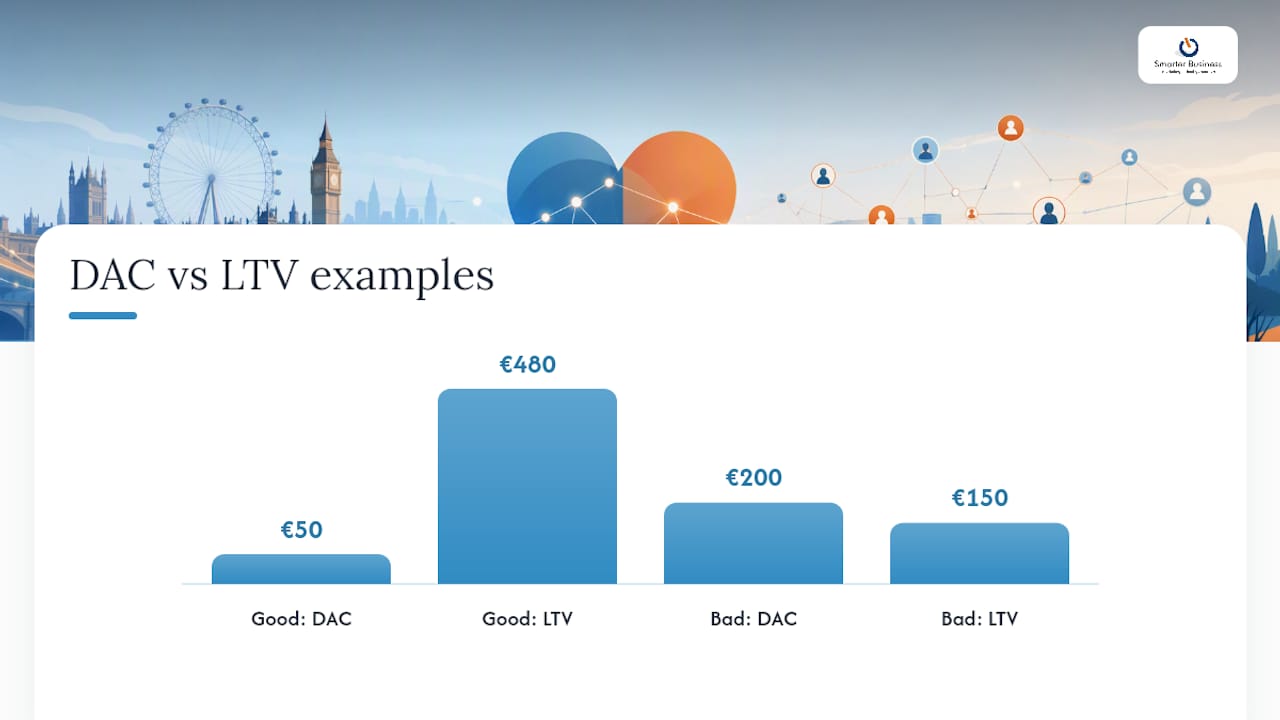
Compare DAC against LTV to sense-check whether acquisition spend is rational. A DAC of €50 against an LTV of €480 is a healthy ratio. A DAC of €200 against an LTV of €150 is a problem hiding in plain sight.
Common pitfalls that quietly wreck DRM programmes
Poor data quality is the most common culprit, but it rarely gets the blame it deserves. When your records are full of duplicates, outdated addresses and missing consent flags, every stewardship effort built on top of them is compromised from the start.
The usual suspects:
- Transactional-only communications — if every message is an ask, donors stop reading; stewardship touchpoints with no ask attached are not optional extras
- Donor fatigue — over-communicating with the wrong message erodes trust faster than silence; segment and cap contact frequency by preference
- Unclear ownership — when nobody owns a donor relationship, nobody stewards it; assign a named owner to every segment and every major-donor portfolio
- Siloed systems — when finance, fundraising and communications each hold different versions of the same donor record, reconciliation becomes a part-time job
- Treating DRM as a CRM project — the software is the enabler, not the strategy; organisations that buy a CRM without redesigning their processes get a very expensive contact list
Red flag to monitor: If your team’s primary use of the CRM is logging gifts after the fact rather than planning future interactions, your DRM is reactive, not proactive. Proactive stewardship — touchpoints planned weeks in advance, not triggered by a donation receipt — is the marker of a mature programme. Check your CRM’s activity calendar: if it is mostly empty between campaigns, that is the gap to close.
UK compliance, Gift Aid, and the stewardship principle that changes everything
UK charities operate under a specific legal and regulatory framework that shapes how DRM must be designed, not just how it is delivered.
GDPR and ICO obligations for donor data:
- You must have a lawful basis for processing each donor’s personal data; for fundraising communications, this is typically legitimate interests (for existing donors) or consent (for new contacts and marketing)
- Consent must be freely given, specific, informed and unambiguous — pre-ticked boxes do not count
- Donors have the right to access their data, correct it, and withdraw consent at any time; your CRM must be able to action those requests promptly
- Retention periods for donor records should be defined in a data retention policy; Gift Aid records must be kept for at least six years after the relevant tax year
- The ICO’s guidance on direct marketing applies to fundraising communications; review it before configuring any automated sequence
Gift Aid checklist for DRM processes:
- Record the Gift Aid declaration (date, method, scope) against the donor record at the point of collection
- Flag whether the declaration covers past, present and future gifts or only specific donations
- Store declarations securely and ensure they are retrievable for HMRC audit
- Capture any changes to a donor’s taxpayer status that would invalidate a declaration
- Include a Gift Aid status field in your segmentation so you can report eligible income accurately
Pro Tip: Map your Gift Aid declaration workflow before configuring your CRM. If the declaration is collected on paper, decide at that point how and when it gets entered digitally — not after 500 records have been imported without it.
The Association of Fundraising Professionals has articulated a principle called mattership — the intentional practice of ensuring every donor interaction communicates that the donor genuinely matters. This goes beyond a thank-you letter. It means designing your stewardship calendar so that donors hear from you when there is no ask coming, receive updates that show the specific impact of their gift, and feel recognised as individuals rather than line items on a report.
Embedding mattership into your DRM means asking, before every communication: does this make the donor feel they matter, or does it make them feel they are being managed? That single question will improve your stewardship faster than any new software feature.
Practical tactics you can test this quarter
The gap between a DRM strategy document and actual donor relationships is closed by small, repeatable actions. Here are the ones with the strongest return.
High-impact tactics to start now:
- Send a personalised thank-you within 48 hours of every gift, referencing the specific campaign or project the donor supported
- Schedule at least two non-ask touchpoints per donor per year — an impact update, a mission story, or a personal check-in call for major donors
- Build an automated welcome series for new donors: gift acknowledgement on day one, impact story on day seven, introduction to the team on day 14
- Assign a named relationship owner to every donor giving above your mid-level threshold
- Use email marketing automation to trigger stewardship sequences based on giving behaviour, not just calendar dates
A 90-day testing plan:
- Select one donor segment (e.g. donors who gave once in the last 12 months but have not renewed)
- Design a three-touchpoint re-engagement sequence: impact update, personal story, soft renewal ask
- Send over 30 days and measure open rate, click rate and renewal conversions against your baseline
- Adjust subject lines, timing or content based on results, then roll out to the next segment
Pairing this with a nonprofit digital marketing checklist helps you align digital channels with stewardship activity so acquisition and retention efforts reinforce each other rather than pulling in opposite directions.
Pro Tip: Test one variable at a time. If you change the subject line, the send time and the content simultaneously, you will never know which change moved the needle. Pick one, measure it, then move to the next.
A CRM consultant’s honest view on where DRM projects go wrong
Most DRM projects that struggle do so for the same reason: the organisation bought software before it designed a process. The CRM becomes a very expensive address book, the team reverts to spreadsheets within six months, and the donor relationships that were supposed to improve quietly deteriorate.
The sequence that actually works is process first, people second, data third, tools fourth. Before any vendor conversation, your team should be able to answer: what does a donor experience in their first 90 days with us? If the answer is “it depends on who picks up the email,” you have a process gap, not a software gap.
What to prepare before briefing a CRM consultant:
- A clean sample data extract showing your current fields, record structure and approximate volume
- A ranked list of your top three priority use cases (e.g. automated acknowledgements, Gift Aid reporting, major-donor portfolio management)
- Two short workflow descriptions: what currently happens, and what you want to happen instead
- Your agreed success metrics so the consultant designs to outcomes, not features
- A realistic timeline and a named internal project owner who has authority to make decisions
Organisations that arrive at a discovery call with those five items move from brief to live system in a fraction of the time of those who arrive with a vague sense that “the CRM needs sorting.”
Smarterbusiness can help you build a DRM programme that actually works
Retaining donors is harder than it looks on a strategy slide, and configuring a CRM to support it is harder still when the software is set up for generic sales pipelines rather than stewardship journeys. Smarterbusiness brings a decade of hands-on CRM consultancy to that exact problem, working with organisations to design the process first and then configure Act! CRM to match it — not the other way around.

A typical DRM engagement covers data audit and cleaning, custom field and table design for Gift Aid and consent tracking, segmentation setup, automation of welcome and stewardship sequences, and staff training so your team can run the system confidently without calling a helpdesk every week. Timelines vary by data complexity, but most organisations reach a working pilot within 60–90 days of a structured brief.
To start, book a discovery call with Smarterbusiness and bring the five briefing items listed above. The conversation will be practical, not a sales pitch — and you will leave with a clearer picture of what your DRM programme needs, whether or not you engage further.
Sources
- Donor Relationship Management | Bridgespan
- Beyond Stewardship: Why Helping Donors Feel They Matter Is the Next Evolution of Fundraising | Association of Fundraising Professionals
- What Do Donor Relations Managers Do: Daily Work & Skills