You have 0 items in your cart

The enterprise customer lifecycle is the complete, repeating sequence of stages a business account moves through, from first awareness of your solution all the way to active advocacy, with retention and expansion woven into every loop. Think of it less like a funnel you pour leads into and more like a flywheel that, when properly maintained, keeps spinning and generating revenue. The five core stages are: Awareness, Acquisition, Onboarding, Expansion/Renewal, and Advocacy. Get them right and you will see higher Customer Lifetime Value (CLTV), lower churn, and faster account expansion. Get them wrong and even your best-won accounts quietly drift away before the renewal window opens.
Three outcomes enterprise leaders consistently report when they manage the lifecycle deliberately:
- Higher CLTV through structured expansion plays and proactive renewal management
- Lower churn by catching adoption stalls before they become cancellation decisions
- Faster expansion because onboarded, successful customers say yes to upsells far more readily than new prospects
The rest of this article covers how Customer Lifecycle Management (CLM) differs from CRM, a stage-by-stage operational map with metrics, a 30–60–90 day implementation plan, and where Smarterbusiness fits in as a practical implementation partner.
Table of Contents
- What the enterprise customer lifecycle actually means
- How CLM differs from CRM, and why you need both
- The five core stages of the enterprise customer lifecycle
- Which KPIs should you track at each lifecycle stage?
- How to operationalise enterprise CLM in your organisation
- Common pitfalls that derail enterprise lifecycle programmes
- Which technology categories support enterprise CLM?
- A copyable enterprise lifecycle map for your next workshop
- Your 30–60–90 day plan to start CLM work
- Key takeaways
- Why most lifecycle programmes stall before they start
- Smarterbusiness helps you put CLM into practice
- Useful sources and further reading
What the enterprise customer lifecycle actually means
Most organisations already know what a sales funnel is. The enterprise customer lifecycle is what happens when you admit the funnel is a fiction. Real enterprise accounts do not drop neatly from awareness to closed-won and stay there. They loop back, stall, re-evaluate, expand into new departments, and then face renewal decisions every twelve or twenty-four months. Enterprise journeys are non-linear; decision cycles have lengthened and customers move back and forth between stages, making cross-channel consistency and journey governance genuinely consequential.
An enterprise lifecycle definition must capture several things a simple funnel ignores:
- Multiple decision-makers. A mid-market SaaS renewal might involve a procurement lead, a finance director, three department heads, and an IT security team, none of whom attended the original demo.
- Long evaluation windows. Enterprise pilots can run for six months before a paid deployment is signed.
- Recursive renewal cycles. Every contract end-date is effectively a new acquisition decision, fought on the ground of adoption and value delivered.
- Post-sale adoption milestones. Whether users actually embed the product into their daily workflows determines whether the account expands or churns, regardless of what the contract says.
Research published in the Journal of the Academy of Marketing Science found that customer journey management can create superior customer value in B2B markets, but institutionalising it is difficult. Many firms fail to achieve expected ROI without cross-functional capabilities and consistent resource usage across internal boundaries. That is not a technology problem. It is a governance problem, and it is exactly why understanding the lifecycle at a conceptual level matters before you buy a single piece of software.
The lifecycle framework treats the customer relationship as a recurring discipline rather than a one-off transaction. ServiceNow describes customer lifecycle management as the process of tracking and analysing each step customers take as they consider, buy, and use a product or service. The enterprise version of that definition adds layers of stakeholder complexity, longer timeframes, and a far greater commercial consequence for each stage transition.
How CLM differs from CRM, and why you need both
This is where a lot of enterprise teams tie themselves in knots. CRM and CLM sound similar, live in overlapping conversations, and often get conflated in budget discussions. They are not the same thing.
Salesforce frames it cleanly: CRM systems focus on capturing, storing, and retrieving customer interaction data. CLM is the analytical and operational discipline that uses that data to manage customer outcomes across stages. Put simply, CRM is the system of record; CLM is the strategy that tells you what to do with what the system knows.
| Dimension | CRM | CLM |
|---|---|---|
| Primary role | System of record | Analytical and operational framework |
| Objective | Store and retrieve interaction data | Manage customer outcomes at each stage |
| Output | Contact history, pipeline data, activity logs | Stage-based playbooks, health scores, renewal alerts |
| Owner | Sales and IT | Cross-functional (marketing, sales, CS, product) |
| Time horizon | Transaction-level | Relationship-level, multi-year |
In practice, the two work as a pair. CLM defines the trigger: a customer’s product adoption score drops below a threshold thirty days before renewal. CRM executes the response: an automated task fires to the customer success manager, a renewal opportunity is created in the pipeline, and a templated outreach sequence begins. Without the CRM, the trigger has nowhere to land. Without the CLM framework, nobody defined the trigger in the first place.
Pro Tip: Start your CLM programme by auditing what your CRM already captures versus what it is missing. The gaps in your CRM data are almost always a map of the lifecycle stages you are currently ignoring. For a deeper look at how CRM and lifecycle management interact in practice, the CLM guide for SMEs from Smarterbusiness is a useful primer.
A short practical example: a B2B software firm signs a new enterprise account in January. The CRM records the closed-won date, the contract value, and the account owner. Without CLM governance, nothing else happens until the renewal reminder fires eleven months later. With CLM in place, the CRM triggers an onboarding task sequence on day one, a health score review at day thirty, a quarterly business review (QBR) invitation at month three, and an expansion conversation prompt at month six. The account team is never flying blind.
The five core stages of the enterprise customer lifecycle
Here is the operational map. Each stage has a distinct character, measurable signals, and a natural functional owner. The boundaries are porous in practice, but the discipline of naming them forces accountability.
| Stage | Key signals | Primary owner |
|---|---|---|
| Awareness | Website visits, content downloads, event attendance, ad engagement | Marketing |
| Acquisition | RFP submission, demo request, pilot agreement, contract signature | Sales |
| Onboarding | User activation rate, time-to-first-value, support ticket volume, training completion | Customer Success |
| Expansion/Renewal | Product adoption depth, NPS score, QBR outcomes, upsell/cross-sell activity, renewal rate | Customer Success + Sales |
| Advocacy | Reference calls, case study participation, NPS promoter score, referral activity | Marketing + CS |
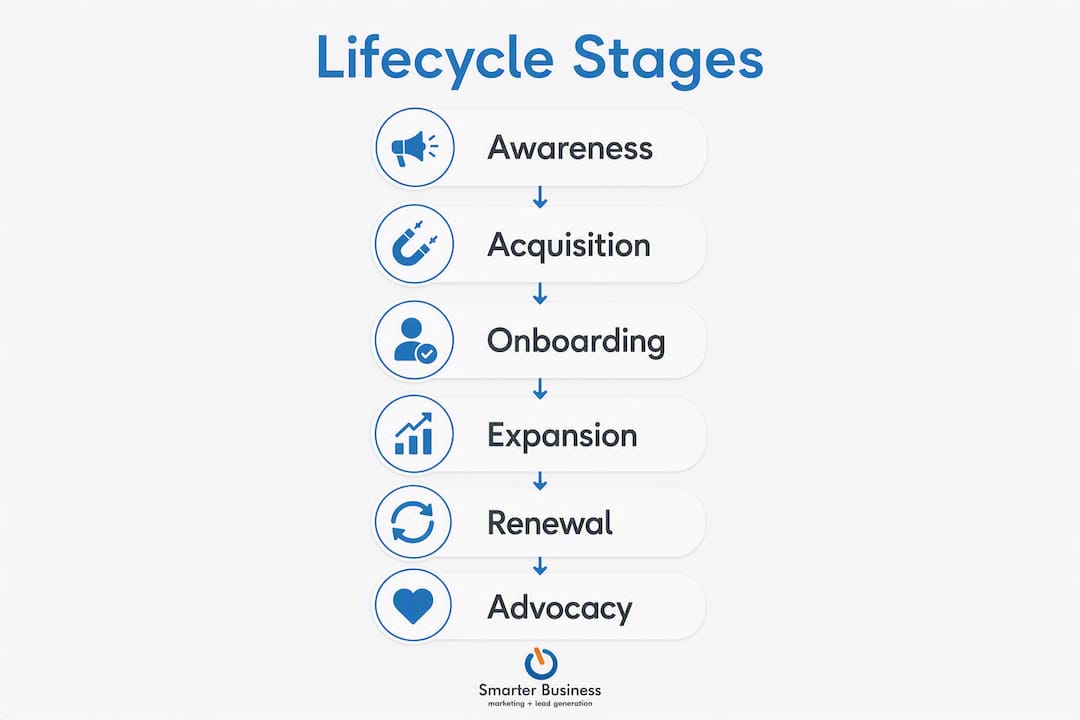
Awareness. This is where the enterprise account first encounters your brand, usually through content, analyst reports, peer recommendations, or events. The signal that matters is intent: a whitepaper download from a procurement director is worth far more than a thousand anonymous page views.

Acquisition. Enterprise acquisition is rarely a single conversation. It typically involves an RFP process, a technical evaluation, a security review, a pilot deployment, and a commercial negotiation. B2B customer journeys involve multiple stakeholders, longer timelines, and ongoing post-purchase stages that B2C frameworks simply do not account for. The signal that closes this stage is a signed contract, but the groundwork for successful onboarding is laid here.
Onboarding. This is where most enterprise accounts are won or lost, and most organisations underinvest in it. The most important work starts after “closed won”: onboarding, technical adoption, and workflow integration determine whether an account churns or expands. Time-to-first-value is the metric that tells you whether onboarding is working. If users are not seeing meaningful outcomes within the first thirty days, the account is already at risk.
Expansion and renewal. A healthy account at renewal is one where users have embedded the product into their workflows, where the QBR conversations are about growth rather than justification, and where the customer success team has documented the value delivered. Expansion MRR and renewal rate are the headline numbers here, but product adoption depth is the leading indicator.

Advocacy. Satisfied enterprise customers who become active advocates, through reference calls, case studies, or peer referrals, are among the most cost-effective acquisition assets a business has. NPS promoter scores and referral activity are the signals to track.
Which KPIs should you track at each lifecycle stage?
Metrics without a stage context are just noise. The table below maps the metrics that matter, why they matter, and how often to review them.
| Metric | Stage | Why it matters | Reporting cadence |
|---|---|---|---|
| Time-to-value (TTV) | Onboarding | Predicts long-term retention; slow TTV correlates with early churn | Weekly during onboarding |
| Product adoption rate | Onboarding/Expansion | Measures whether users embed the product in daily work | Monthly |
| Net Promoter Score (NPS) | Retention/Advocacy | Signals satisfaction and advocacy potential | Quarterly |
| Customer Lifetime Value (CLTV) | All stages | Aggregate revenue measure; guides investment decisions per account tier | Quarterly |
| Renewal rate | Expansion/Renewal | Direct measure of retention health | Monthly |
| Churn rate | Retention | Lagging indicator of lifecycle failures upstream | Monthly |
| Expansion MRR | Expansion | Measures upsell and cross-sell success | Monthly |
| Health score | All post-sale stages | Composite leading indicator combining adoption, support, NPS, and engagement | Weekly |
A few practical notes on making these metrics trustworthy. First, every metric in the table above is only as good as the data feeding it. If your CRM holds incomplete contact records, your NPS survey goes to the wrong person. If your product telemetry is not integrated with your customer success platform, your health score is guesswork. Without integrated visibility across platforms, enterprises risk silent churn; leaders should prioritise integrating data and automated triggers to capture renewal and adoption windows before they close.
Second, the reporting agenda matters as much as the metrics themselves. A useful cadence for enterprise leaders:
- Weekly: health score alerts, onboarding progress, open support escalations
- Monthly: renewal pipeline, churn rate, expansion MRR, adoption cohort analysis
- Quarterly: CLTV by account tier, NPS trends, QBR outcomes, lifecycle stage distribution
The role of CRM in customer retention is precisely this: to serve as the single source of truth that makes all of the above reportable without a manual spreadsheet exercise every month.
How to operationalise enterprise CLM in your organisation
Knowing the framework is one thing. Getting forty people across marketing, sales, customer success, product, and IT to operate it consistently is quite another. Here is a practical sequence.
- Discovery and mapping (weeks 1–4). Audit your current state: what lifecycle data does your CRM hold, what is missing, and where do accounts stall most often? Map the current journey from the customer’s perspective, not the internal process map.
- Define stage ownership (weeks 3–6). Assign a primary owner and a secondary owner for each stage. Use a RACI model: who is Responsible, Accountable, Consulted, and Informed for onboarding, renewal management, and expansion campaigns.
- Configure your CRM to track lifecycle stages (weeks 4–8). Custom fields, custom tables, and workflow automations should reflect your stage map. If your CRM cannot record a health score or fire a renewal alert, it is not yet fit for CLM.
- Build playbooks for the highest-impact stages (weeks 6–10). Onboarding and renewals first. These two stages have the greatest direct impact on CLTV and churn, and they are the easiest to instrument.
- Pilot on a defined account cohort (weeks 8–12). Select ten to twenty accounts that represent your typical enterprise customer. Run the playbooks, measure TTV, health scores, and renewal outcomes. Document what breaks.
- Review, iterate, and scale (month 3 onwards). Use the pilot data to refine playbooks, fix data gaps, and build the governance model for a full rollout.
A RACI outline for the three most critical lifecycle activities:
| Activity | Responsible | Accountable | Consulted | Informed |
|---|---|---|---|---|
| Onboarding delivery | Customer Success Manager | Head of CS | Product, IT | Sales, Finance |
| Renewal management | Account Manager | Sales Director | CS, Legal | Finance, Leadership |
| Expansion campaigns | Marketing | Revenue Lead | CS, Product | Sales |
Pro Tip: Do not try to fix every stage at once. Onboarding and renewals are where the money is. A well-run onboarding programme reduces early churn; a well-managed renewal process protects the revenue base. Start there, prove the model, then expand.
Common pitfalls that derail enterprise lifecycle programmes
Even well-resourced enterprises stumble on the same obstacles. Knowing them in advance is half the battle.
- Treating “closed won” as the finish line. Sales teams are incentivised on new bookings, not on whether the account is still healthy at month eighteen. Without a formal handoff protocol and post-sale ownership, accounts drift. The fix: a documented handoff process with a named customer success owner assigned at contract signature, not after the first support ticket.
- Data silos between functions. Marketing holds campaign engagement data. Sales holds pipeline notes. Customer success holds health scores. Product holds usage telemetry. When none of these talk to each other, the account team is operating on a fraction of the available signal. The fix: a single source of truth, usually the CRM, with integrations pulling data from each system.
- Misaligned KPIs across teams. If marketing measures leads, sales measures bookings, and customer success measures NPS, nobody is measuring the lifecycle as a whole. The fix: a shared set of lifecycle KPIs that every function reports against, reviewed in a joint forum.
- Lack of cross-functional ownership. Academic research confirms that customer journey management requires integrated capabilities across internal boundaries. A lifecycle programme owned by one team and ignored by three others will not survive its first renewal cycle.
- Silent churn. This is the most insidious pitfall. An account goes quiet: no support tickets, no QBR requests, no product usage spikes. The team assumes everything is fine. Then the renewal comes up and the customer says they have already evaluated alternatives. The fix: automated engagement monitoring with alerts when an account’s activity drops below a defined threshold, well before the renewal window opens.
Measurement and experimentation matter here too. When you implement a mitigation, define a success criterion before you start. If you redesign the onboarding sequence, decide in advance what a successful outcome looks like: a TTV reduction of a specific number of days, a support ticket volume drop, or an adoption rate improvement. Without that pre-commitment, you will not know whether the fix worked.
Which technology categories support enterprise CLM?
Technology does not run a lifecycle programme. People and processes do. But the right tools make the programme measurable and scalable. Here are the core categories to evaluate.
- CRM as system of record. The foundation. Every account, contact, interaction, and lifecycle stage lives here. For enterprise CLM, the CRM must support custom fields, custom tables, workflow automations, and integration APIs. Act! CRM, configured by a certified consultancy, covers this ground well for mid-market organisations.
- Customer success platforms. Tools that aggregate health scores, track adoption milestones, and manage QBR workflows. They sit on top of the CRM and pull data from product telemetry and support systems.
- Analytics and behavioural telemetry. Product usage data, session recordings, and event streams that tell you whether users are actually adopting the product. Without this layer, your health score is based on sentiment surveys alone.
- Integration and ETL tools. The plumbing that connects CRM, customer success, product analytics, and support into a single data flow. Without integration, every team is working from a different version of the truth.
- Automation and orchestration. Workflow tools that fire the right action at the right time: an onboarding task sequence on day one, a renewal alert at day 270, an expansion prompt when adoption crosses a threshold.
- Reporting and BI. Dashboards that surface lifecycle KPIs for operational teams and executive scorecards. The goal is a single view of the lifecycle, not six separate reports from six separate systems.
Procurement tips for enterprise buyers: scope a proof of concept before committing to a full deployment. Check security and compliance certifications relevant to your industry. Assess integration readiness with your existing CRM before signing. And budget for total cost of ownership, including implementation, training, and ongoing support, not just the licence fee. For context, enterprise CRM and customer success platform licences typically run from a few hundred to several thousand euros per user per year, depending on the tier and configuration. Reviewing Act! CRM features is a useful starting point for understanding what a well-configured CRM can deliver for lifecycle tracking at mid-market scale.
A copyable enterprise lifecycle map for your next workshop
Paste this into a whiteboard session or a slide deck to align stakeholders quickly. It covers a typical long-decision B2B enterprise account.
Stage 1: Awareness (months 1–3)
- Touchpoints: content downloads, event attendance, analyst briefings, peer referrals
- Milestone: named contact identified and engaged by marketing
Stage 2: Acquisition (months 3–9)
- Touchpoints: discovery call, RFP response, technical demo, security review, pilot agreement, contract negotiation
- Milestone: signed contract and handoff pack delivered to customer success
Stage 3: Onboarding (months 1–3 post-signature)
- Touchpoints: kickoff call, technical integration review, user training sessions, first QBR at day 30
- Milestone: time-to-first-value achieved; adoption rate above agreed threshold
Stage 4: Expansion and renewal (months 4–12 and recurring)
- Touchpoints: monthly health score review, QBRs at months 3, 6, 9, renewal conversation at month 9, upsell/cross-sell proposal
- Milestone: renewal signed; expansion MRR recorded
Stage 5: Advocacy (ongoing)
- Touchpoints: NPS survey, case study invitation, reference call request, peer referral programme
- Milestone: active promoter status confirmed; referral or case study delivered
For a shorter renewal-driven account (twelve-month contract, established product), compress stages 1–2 into a sixty-day evaluation cycle and move directly to onboarding in month two. The touchpoints remain the same; the timelines shrink.
Touchpoint checklist to verify on any lifecycle map: onboarding kickoff call, technical integration review, day-30 health check, QBR at month three, renewal conversation at month nine, NPS survey at month eleven.
Your 30–60–90 day plan to start CLM work
This is the plan you can assign, measure, and report on within a single quarter.
-
Days 1–30: Discovery and mapping.
- Senior sponsor: commission a lifecycle audit covering CRM data quality, stage ownership gaps, and current churn patterns.
- Programme lead: map the current customer journey from the customer’s perspective across all five stages.
- Data owner: identify integration gaps between CRM, product analytics, and support systems.
- Success criterion: a documented lifecycle map with named owners for each stage and a prioritised list of data gaps.
-
Days 31–60: Pilot on onboarding and renewals.
- Delivery squad: configure CRM workflows for onboarding task sequences and renewal alerts on a cohort of ten to twenty accounts.
- Programme lead: run the playbooks, track TTV and health scores weekly.
- Senior sponsor: review pilot data at day 60 and approve or adjust the playbooks.
- Success criterion: measurable improvement in TTV or renewal pipeline visibility versus the pre-pilot baseline.
-
Days 61–90: Scale and governance.
- Data owner: close the highest-priority integration gaps identified in day 1–30.
- Programme lead: extend playbooks to the expansion and advocacy stages.
- Senior sponsor: establish a joint lifecycle review forum with representation from marketing, sales, customer success, and product.
- Success criterion: lifecycle KPI dashboard live and reviewed in the first joint forum; governance model documented.
If your team lacks the CRM configuration expertise to execute steps two and three internally, that is exactly the point at which an external consultancy adds the most value. Smarterbusiness offers a structured engagement model covering discovery, CRM configuration, playbook design, and team training, so you are not rebuilding the wheel from scratch. The CRM consultancy process page explains how that engagement works in practice.
Key takeaways
The enterprise customer lifecycle is an ongoing revenue discipline, not a one-time sales process, and managing it deliberately is what separates organisations with predictable growth from those playing catch-up at every renewal.
| Point | Details |
|---|---|
| Lifecycle is a recurring discipline | Treat every renewal as a new acquisition decision; the work never stops at “closed won.” |
| CLM needs CRM data, but is not CRM | CRM stores the record; CLM is the strategy that acts on it across all five stages. |
| Prioritise onboarding and renewals first | These two stages have the greatest direct impact on CLTV and churn; pilot here before scaling. |
| Assign cross-functional ownership | Each lifecycle stage needs a named owner; shared KPIs reviewed in a joint forum prevent siloed effort. |
| Smarterbusiness supports implementation | Smarterbusiness offers CRM consultancy, Act! CRM configuration, and team training to operationalise CLM for mid-market enterprises. |
Why most lifecycle programmes stall before they start
The conventional wisdom says enterprises fail at customer lifecycle management because they lack the right technology. After working with organisations across sales, marketing, and operations, the pattern is almost always the opposite: they have plenty of technology and almost no governance.
Teams buy a CRM, configure it for the sales process, and then stop. The post-sale stages, onboarding, adoption, renewal, advocacy, get bolted on as an afterthought, owned by nobody in particular, and measured inconsistently if at all. The result is a system of record that records the wrong things, and a lifecycle programme that exists on a slide deck but not in anyone’s daily workflow.
The insight that changes this is deceptively simple: the lifecycle is a revenue discipline, not a technology project. The technology is the enabler. The discipline is the decision about who owns each stage, what success looks like at each transition, and what happens when an account stalls. Get those decisions made first, then configure the tools to support them.
There is also a tendency to over-engineer the first version. A lifecycle map with twenty-three stages, fourteen KPIs, and a six-month implementation timeline will not survive contact with a busy enterprise team. Start with five stages, three metrics per stage, and a pilot on your highest-value accounts. Prove the model in ninety days, then scale. The organisations that get this right are not the ones with the most sophisticated tools. They are the ones that made the governance decisions early and kept the framework simple enough for every team member to use without a manual.
Smarterbusiness helps you put CLM into practice
Knowing the framework is the easy part. Configuring your CRM to actually track lifecycle stages, fire renewal alerts, and surface health scores for your account team is where most enterprises stall.
Smarterbusiness has been implementing and customising Act! CRM for organisations since 2014, with a focus on making the system reflect how your business actually operates, not how a generic template assumes it does. The engagement model is straightforward: a discovery session to map your current lifecycle and data gaps, a configuration phase to build the workflows and custom tables your stages require, a pilot on a defined account cohort, and a training programme so your team can run it independently. You bring the accounts and the process knowledge; Smarterbusiness brings the CRM expertise and the lifecycle framework.
If your team needs CRM training to embed lifecycle workflows into daily practice, or a certified Act! CRM consultant to handle the configuration work, the next step is a discovery call to scope what your programme needs.
Useful sources and further reading
The sources below underpin the frameworks and claims in this article. Each is worth reading in full for the use case noted.
- Customer Lifecycle Management overview, ServiceNow: operational definition and five-stage overview; best starting point for teams new to CLM.
- Customer journey management in B2B markets, Journal of the Academy of Marketing Science: academic evidence on cross-functional capabilities and ROI; use for governance and business case arguments.
- Beyond the funnel: enterprise customer journeys, Elixirr Digital: practitioner advice on non-linear journeys and micro-moment design; useful for journey mapping workshops.
- B2B customer journey mapping guide, Miro: practical template and guidance for multi-stakeholder B2B maps; download the free template for your workshop.
- Customer Lifecycle Management, Salesforce: clear CRM vs CLM distinction; useful for internal alignment conversations.
- Customer retention strategy guide, Pipedrive: practitioner-level advice on post-sale milestones and CRM configuration for retention.
- Enterprise CLM overview, MDS Media: enterprise-specific stage guidance and data integration recommendations.
- Smarterbusiness CLM guide for SMEs: practical CRM and CLM integration guidance from Smarterbusiness, tailored for mid-market organisations.